
You have a draft sponsor-bank agreement and a launch date. Then you get to the insurance section and see several policies, limits and terms you’ve never had to buy before. This is a good time to bring in an insurance broker. The broker needs to see what the contract says and understand how your payment program will actually work.
I asked Frank Costa of World Insurance Associates what he’d want a FinTech founder to know before requesting a first quote. Here’s what to do while you still have time to get answers.
- Start during contract discussions. Frank suggests allowing 60 to 90 days before you need the policy in force, when possible.
- Send the insurance clauses from your draft agreements. A list of limits leaves out wording that can affect which policy you need and when you need it.
- Explain how you operate. Give your broker a short business plan, a picture of how funds move, and estimates of transaction volume and sensitive records.
Start With Free Payments Training
New to a payments launch? Start with Introduction to Payments and learn how issuing banks, processors, and program managers work together.
Watch The Full Interview With Frank Costa
40 minutes, 21 seconds. Captions are visible on screen.
Interview Chapters
- 00:00 — When a $1 million cyber limit fell short
- 00:26 — Introduction
- 02:07 — When to start the insurance process
- 07:41 — Common coverage mistakes
- 10:53 — Coverage for the platform, money, and people
- 15:54 — How to choose coverage limits
- 20:14 — Negotiating sponsor-bank requirements
- 22:30 — Getting an insurance quote
- 28:00 — Exclusions and coverage gaps
- 31:14 — Pricing and submitting a strong application
- 38:34 — Frank’s final advice
- 39:31 — How to reach Frank
- 40:13 — Frank’s contact details
When Should A FinTech Start Shopping For Insurance?
Work backward from the first date you’ll need coverage. That could be a partner’s deadline for proof of insurance, a funding round, a first hire, or the date you start handling live customer funds or data. Give the broker the draft language and the target effective date. Ask which requirements apply at signing and which apply at go-live. For a new card program, those dates can move as you work through the issuing-bank and processor decisions.
If you’re still raising money or putting a board together, ask who could be sued over a decision the founders or directors make today. Directors and officers liability insurance (D&O) can respond to certain claims alleging wrongful management decisions. Bring the funding and board plans to the broker so you can discuss when that coverage makes sense.
Which Policies Should You Ask About?
Start with what could go wrong. A breach, a payment error, and a fraudulent transfer can all cost money, but they raise different coverage questions.
- Cyber liability. If someone gets access to customer information, ask how the policy treats incident response, customer notification, interruption to your business, and claims against your company.
- Technology errors and omissions (tech E&O). If your software sends the wrong payment instructions and a client claims it suffered a financial loss, ask whether the work you perform and that type of claim are within the proposed coverage.
- Commercial crime. If an employee is tricked into sending a wire, ask how the quote treats social engineering and funds transfer fraud. Check whose funds must be lost, what transfer verification the policy requires, and whether a lower limit applies to that specific kind of loss.
These are questions to bring to your broker. Ask which policy could respond, especially where cyber, technology errors, and crime overlap. CFC’s introduction to FinTech insurance explains why assuming that related policies fit together can leave gaps.
Is The Sponsor Bank’s Minimum Enough?
Frank described a client whose bank required $1 million in cyber liability coverage. The fintech held data on about 300,000 customers. When Frank’s team looked at what notification and breach response could cost, they estimated that this client needed at least $3 million. That was an analysis of one company’s exposure.
When you talk to your own broker, ask them to walk through a plausible loss. How many customers could be affected? How long could your platform be down? Who owns any funds that could be lost? Then compare the proposed limit, the amount your company is responsible for on a covered claim (the retention), and any smaller cap for a particular event (a sublimit). This makes it easier to understand what the sponsor bank is asking for and what the quote could actually do for you.
What Should You Bring To Your First Broker Call?
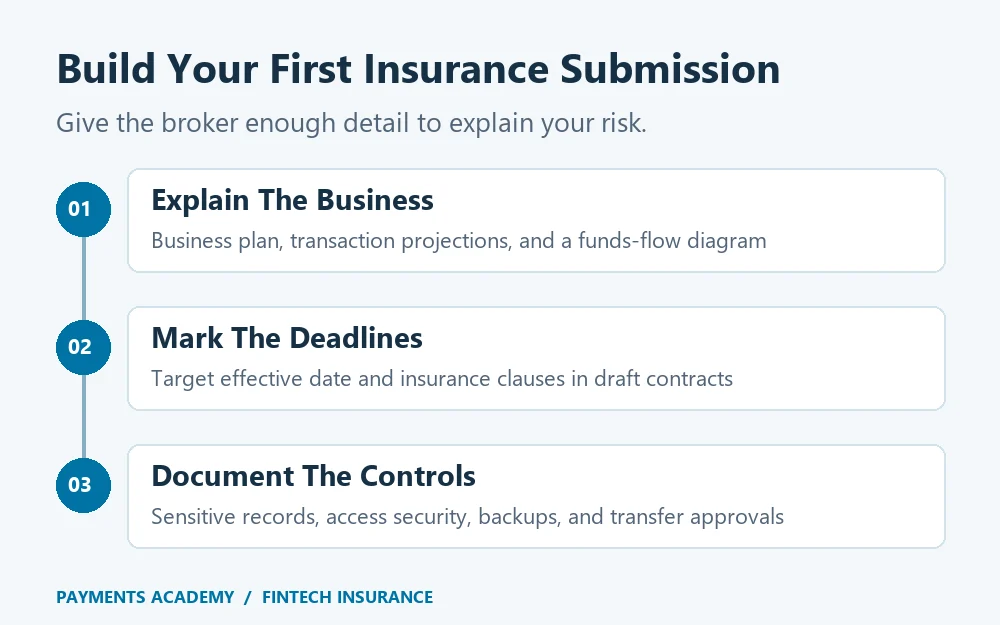
Frank stressed that the underwriter needs to understand the business behind the application. If you’re pre-launch, use your projections and label the assumptions. A funds-flow diagram can be especially useful. Show who receives the money, who holds it, which parties can move it, and where your company’s role ends.
For each estimate, write down what it covers and who owns it. Your finance lead can explain forecast transaction volume and how it was calculated. Your security lead can confirm what’s deployed today and what’s scheduled for later. For transfer controls, show who can initiate, approve, and release a payment and how your team verifies changed instructions.
Get Frank’s Insurance Readiness Checklist
Use it to prepare for your first broker call and compare limits and exclusions. The PDF is free to download without an account.
Talk With Frank Costa
Frank Costa, CIC, CRM is a principal and national growth leader at World Insurance Associates. If you’re preparing for a first quote, tell him what you’re launching, when you need coverage, and which partner agreements are in draft.
Call 201-918-1778 · Connect On LinkedIn · World Insurance Profile
Keep Learning With Payments Academy
Create a free account to start Introduction to Payments, Compliance Rules and Regulations, or Information Security Awareness.
